
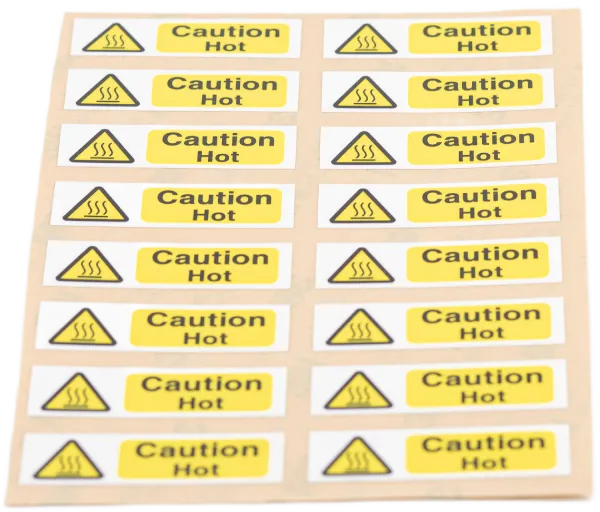
A self-adhesive label looks like a simple item until something goes wrong with it. The print fades in UV. The adhesive lifts at the corners after an autoclave cycle. The substrate cracks in vibration. The label survives the operating environment, but the ink does not.
In regulated industries – aerospace, medical, transport and high-specification industrial – those failures aren’t cosmetic. They’re a compliance event, a rework, a delayed delivery or a rejected lot. The fix is to specify the label properly in the first place. This guide walks through what that means in practice.
What “self-adhesive labels” actually covers
For most buyers, the term self-adhesive labels covers any printed label supplied with a pressure-sensitive adhesive on the back. The face material varies – polyester, polyimide, vinyl, paper, void films, even thin metal foils – and so does the adhesive. The right combination depends on what the label has to do, where it has to live, and for how long.
At Southern, around 90% of what we produce sits inside this category. That includes simple adhesive labels for product identification, but also small adhesive labels for component marking, traceability and compliance – and self-adhesive traffolyte labels (engraved laminate with an adhesive backing) for control-panel and instrument identification.
How to specify a self-adhesive label
Five questions decide most of the specification. Answer them upfront and your label supplier can come back with the right material on the first pass.
- What is the substrate it has to stick to?
Steel, aluminium, painted metal, polycarbonate housing, silicone over-mould, a textured composite – every surface has a different surface energy, and that drives adhesive selection. A label that works on stainless steel may peel off polypropylene within a week. - What is the operating environment? Temperature range matters most. A standard adhesive label is rated for roughly -20°C to +80°C. Above that, you are into high temperature labels and heat resistant labels – polyester with a high-temp acrylic adhesive (up to ~150°C) or polyimide (up to ~260°C continuous, higher in short bursts). Add in chemicals, solvents, cleaning agents, UV and humidity, and the material list narrows further.
- What is the expected service life?
A short-life production label has different requirements to a 20-year nameplate. Service life affects substrate weight, ink system, and whether you need a protective over-laminate. - What information has to stay legible?
Human-readable text, a 2D barcode, a serial number, a UDI block, a CE / UKCA mark. Each has a minimum size, a minimum contrast and a minimum print resolution to remain machine-readable for the life of the label. - Does it need to come off cleanly?
Most labels are designed to stay where they are. Some – sterile-pack identification, temporary asset tags, removable kanban labels – are designed to come off without residue, often within a defined window. Removable adhesives are a separate product category and have to be specified deliberately.
Substrate options at a glance
Polyester
The workhorse for industrial adhesive labels. Dimensionally stable, chemical-resistant, prints crisply across screen and digital. Good UV performance with the right ink and over-laminate.
Polyimide
High-temperature performance for environments where polyester fails – engine bay, autoclave, electronics reflow, PCB marking. The default for high-temperature labels and heat-resistant labels in regulated industries.
Vinyl
Flexible and conformable. Used where the label has to wrap around a curved or textured surface – equipment housings, cable bundles, fleet identification.
Void / destructible films
Self-adhesive labels designed to leave evidence of tampering. The face material either lifts a pattern (VOID) or fractures on removal. Used for security seals, asset control and warranty marking.
Self-adhesive traffolyte (engraved laminate)
A two-tone phenolic or acrylic laminate, engraved and supplied with a pressure-sensitive adhesive back. Specified for control-panel identification, instrumentation and operator interfaces where engraved permanence is needed without mechanical fixing.
Adhesive systems matter as much as the face material
Buyers often specify the face material in detail and leave the adhesive as “permanent”. That is a mistake. The adhesive controls how the label performs across the working life:
- Permanent acrylic – the default. Strong, weather-resistant, broad temperature range.
- High-temperature acrylic – for paint-bake, engine compartment and autoclave applications.
- Removable – designed to leave no residue, within a defined window.
- Low-surface-energy – for polypropylene, polyethylene and other plastics where standard acrylic will not bond.
- Rubber-based – high initial tack on rough or contaminated surfaces, lower temperature performance.
What you should get from your label supplier
For regulated work, a supplier should give you more than a printed label. Expect a documented specification (face material, adhesive, ink system, finish, dimensions, tolerances), a production proof to sign off, a certificate of conformity with each delivery, and material traceability on request.
At Southern we run every self-adhesive label order under EN 9100 and ISO 9001 quality management. Substrate, adhesive and ink batches are recorded against the production order, so if a buyer needs to trace a label back to its production data weeks or years later, the record is there.
When to ask for help early
If any of the following apply, get the supplier in early – at brief stage, not after a sample has failed:
- The host material is plastic or composite.
- The label sees sustained temperatures above 80°C.
- The label is part of a UDI, traceability or compliance pack.
- The label has to survive autoclave, gamma, EtO or industrial-cleaning cycles.
- The label has to come off cleanly within a defined service window.
Next step
If you’re scoping a self-adhesive label programme – or replacing one that has not performed – send us the substrate, the environment, the compliance scope and the lead time. We will come back with a costed material specification within one working day.