
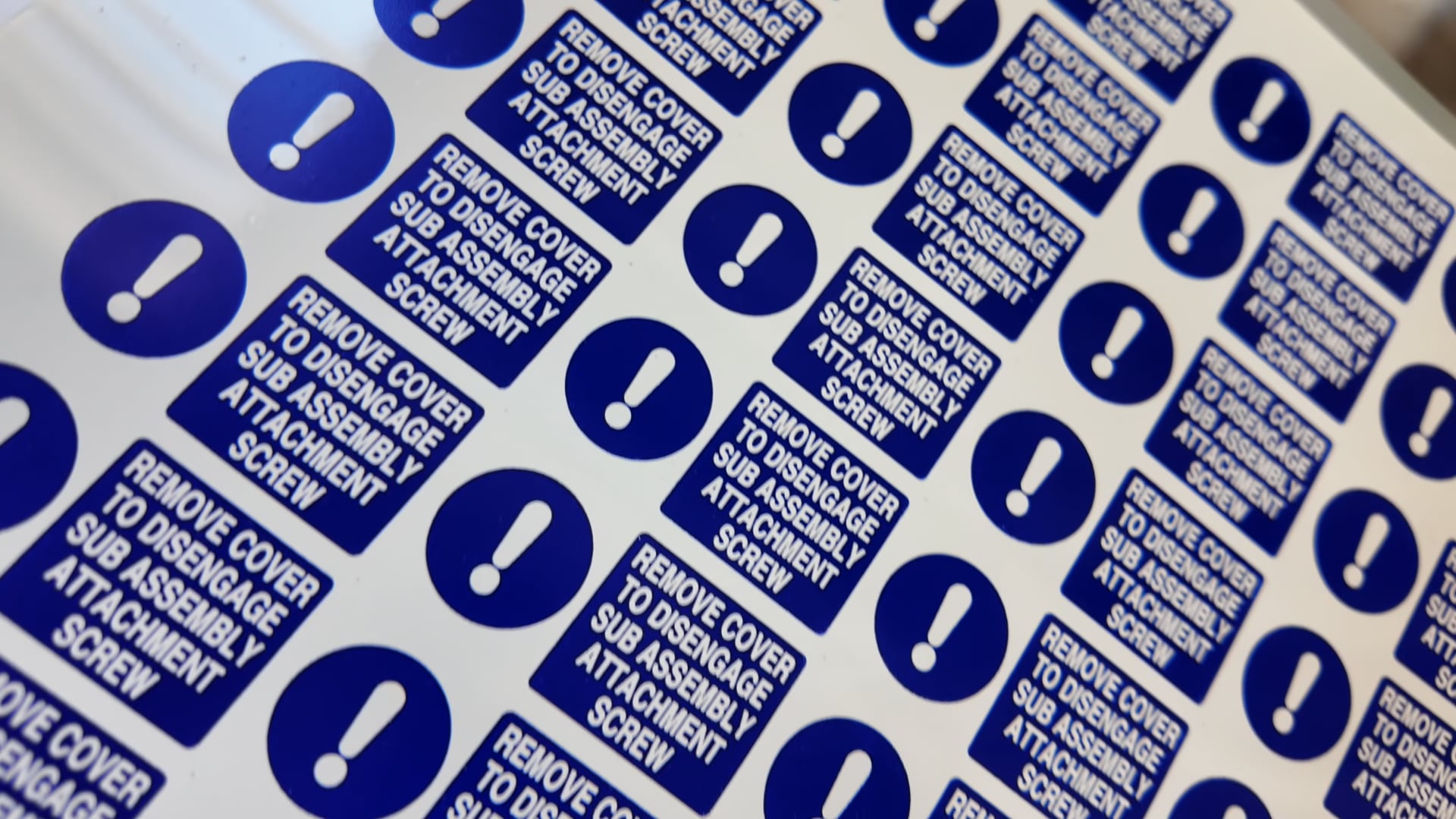
Laser marking vs chemical etching: Which marking process is right for your nameplate?
Both laser marking and chemical etching are designed to produce permanent industrial marks on metal – typically aluminium or stainless steel – that will survive the operating environment for the life of the equipment. They are not, however, interchangeable. The right choice depends on the substrate, the level of detail, the run size and the documentation behind the part.
This article walks through how to decide.
What laser marking actually is
Laser marking covers several distinct processes that all use a focused laser beam to alter a metal surface – by ablation, annealing, oxidation or engraving. The result is a high-contrast, durable mark that becomes part of the substrate rather than sitting on top of it.
- Laser engraving – the laser removes material to create a recessed mark. The deepest, most tactile result.
- Laser etching – a more controlled, shallower process. The laser melts the substrate so that the surface rises and changes colour or texture.
- Laser annealing – used on stainless steel; the laser heats the substrate to create a colour change without removing material. Ideal where surface integrity must be preserved.
Buyers refer to laser marking services, industrial laser marking and laser marking and engraving more or less interchangeably. The supplier should be specific about which process they are running and on what substrate.
What chemical etching actually is
Chemical etching – sometimes called the chemical etching process, photochemical etching, photo-etching, chem etch, acid etching metal or engraving acid – uses a controlled acid-based process to dissolve unprotected areas of a metal sheet. A photographic mask defines where the etch occurs; the result is a permanent, sub-surface recess in the metal.
When the etched area is filled with a pigment and over-finished (often with an anodising layer on aluminium), the result is a flat, abrasion-resistant, sub-surface mark that survives industrial wear far better than anything sitting on top of the substrate.
Etching stainless steel is a common application. The same process produces precision components, decorative finishes and identification plates.
How to choose
Choose laser marking when:
- You need variable data – sequential serialisation, lot codes, 2D barcodes or per-part traceability.
- You need fast turnaround on a low-to-mid volume run.
- You need fine detail in a small area – laser etched marks down to fractions of a millimetre are routine.
- You are marking parts that are already manufactured – laser is non-contact and tooling-free.
- You are working on stainless steel or coated surfaces where laser annealing is the lowest-impact route.
Choose chemical etching when:
- You need high volumes of identical or near-identical plates.
- You need sub-surface protection – the etch is below the surface and can be filled and anodised over.
- You need fine detail across a whole sheet at the same time – chemical etching delivers consistent quality across a large array.
- You need very thin, complex profiles cut and marked in one operation.
- The plate has to look right under close inspection – chemical etching gives a clean, professional finish that is hard to match with any other process.
A short comparison
Setup: Laser: minimal, software-driven. Chemical: photographic mask required up front.
Volume: Laser: economical at any volume. Chemical: cost per plate falls sharply with volume.
Variable data: Laser: native. Chemical: requires per-mask change – practical for batches, not for per-part serialisation.
Detail: Both deliver fine detail. Laser excels at very small marks; chemical excels at large sheets of consistent detail.
Protection: Laser: surface change. Chemical: sub-surface recess, fillable and over-finishable.
Materials: Laser: most metals and many plastics. Chemical: best on aluminium, stainless, brass and other etchable metals.
When you should use both
For many industrial nameplates the answer is not one or the other. Run the bulk plate via chemical etching, with the manufacturer’s name, brand, fixed information and CE / UKCA marks photo-etched and anodised over. Then add the variable data – serial number, lot code, date of manufacture – by laser at the point of issue.
This split keeps unit costs low for the run while preserving variable-data traceability on a per-part basis. It is how most volume aerospace and rail nameplate programmes are produced.
How Southern handles it
Southern runs both processes under one quality system. Briefs come in for an industrial engraving requirement, a chem-etch programme, a laser-marking service or a hybrid of all three – and the right process is chosen against the brief, not the price list. Each order is delivered with a certificate of conformity and, where required, full material traceability.
Next step
Send us a drawing, an information block and a quantity range. We will come back with a process recommendation, a costed proposal and a production proof for sign-off.